
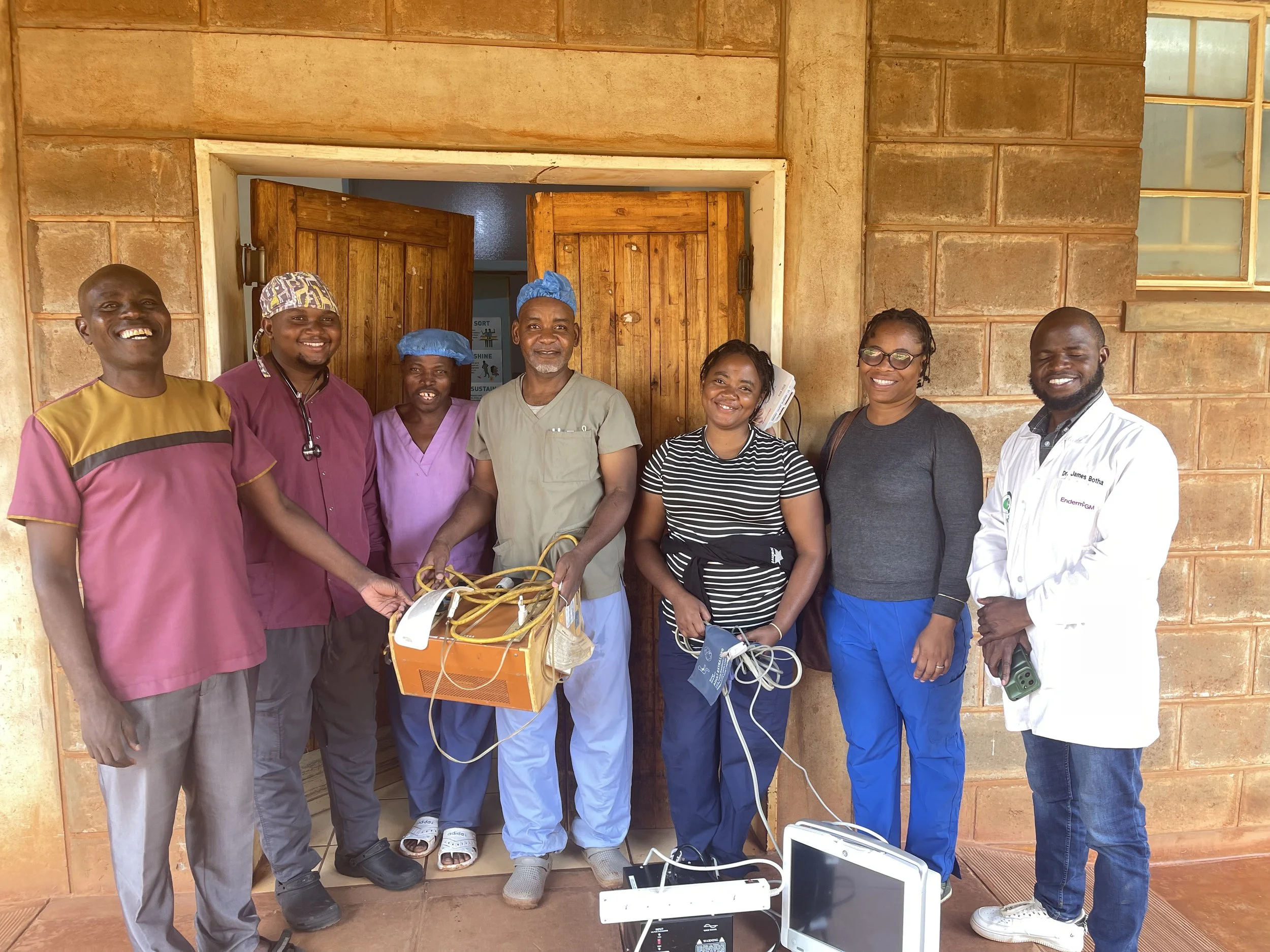
What began with careful planning and a few unexpected challenges ended in triumph for five women who successfully received surgery during our February Goiter Camp. Their courage and the dedication of our team remind us what’s possible when compassion and determination meet.
In January, Access Health Africa (AHA) Program Manager Beatrice and longtime AHA partner Dr. Nelson, accompanied 12 women to Kamuzu Central Hospital (KCH) to begin their pre-surgical workup for goiter removal. This critical preparation includes blood testing to check thyroid levels and, when necessary, starting medications to ensure each patient is ready and safe for surgery.
Transportation is often one of the greatest barriers to accessing healthcare in Malawi. To reduce this obstacle, AHA covered transport costs for these patients to travel to both AHA and KCH appointments. Of the 12 women evaluated, 11 were initially cleared for surgery, with some needing medications to bring their thyroid activity into an acceptable level. A few were later found to have additional medical conditions that will further delay their procedures, but AHA staff and Dr. Nelson remain in close contact with these women to ensure they are rescheduled - either at KCH or during a future AHA goiter camp.
Our February Goiter Camp was organized in partnership with Kabudula Community Hospital. In advance of the camp, our teams conducted planning meetings to confirm that surgical outlets and lights were functioning, coordinated laundry and meal services, and arranged for patients to arrive the evening before their procedures.
However, the first day brought an unexpected twist. Upon arrival at Kabudula, our team discovered there was no water and no electricity. The hospital typically relies on a backup generator to power the surgical theatre, but unfortunately, it was not working.
Without hesitation, Dr. Nelson, the AHA team, and hospital administrators from both Kabudula and Mitundu Community Hospital collaborated to relocate the entire camp. Patients, guardians, and supplies were transported via the Kabudula ambulance, fueled specifically by AHA for this urgent transfer, to Mitundu. Meanwhile, the AHA team made the nearly two-hour drive in the opposite direction to regroup and set up.
Upon arrival at Mitundu, both hospital and AHA staff moved quickly to prepare the theatre. After hours of travel, coordination, and pivoting plans, the first patient entered surgery at 1:15 p.m. Despite the delays, the team successfully completed two surgeries on Monday.
Tuesday proceeded smoothly at Mitundu, with three additional patients receiving surgery. During the day, two maternity patients at Mitundu required emergency cesarean sections. Our teams worked collaboratively to ensure that every patient - mothers and surgical patients alike - received the care they needed. Amid the intensity of the day, we are always grateful to celebrate the safe delivery of babies.
Pre-surgical evaluations sometimes reveal underlying medical conditions. In Malawi, high blood pressure is commonly discovered during surgical workups. One goiter patient had been recently diagnosed with hypertension. She was started on medication and scheduled for follow-up at KCH the following week, ensuring continuity of care beyond the camp itself.
Communication can also be a significant challenge. Unlike in many countries, landlines are virtually nonexistent in Malawi. Most people rely on prepaid phones to make calls. While mobile plans may seem inexpensive compared to the United States, when a family’s income depends on selling tomatoes or other small-scale goods, purchasing airtime is not always possible.
For this reason, AHA routinely collects at least two contact numbers per patient to improve the chances of reaching them. Even so, staying connected can be difficult. These realities underscore why accompaniment, follow-up, deep relationship with our community partners, and persistent communication are essential components of our work.
This camp was marked by flexibility, teamwork, and determination. What began as a logistical setback became a testament to partnership and perseverance. Through strong collaboration with local hospitals and dedicated staff, five women received life-changing goiter surgeries - despite a relocation, power outages, and water shortages.
At Access Health Africa, we remain committed not only to providing surgery, but to walking alongside patients every step of the way - removing barriers, solving problems, and ensuring access to safe, quality care.